
Young Researcher Paper Award 2025
🥇Winners
🥇Winners
Print: ISSN 0914-4935
Online: ISSN 2435-0869
Sensors and Materials
is an international peer-reviewed open access journal to provide a forum for researchers working in multidisciplinary fields of sensing technology.
Online: ISSN 2435-0869
Sensors and Materials
is an international peer-reviewed open access journal to provide a forum for researchers working in multidisciplinary fields of sensing technology.
Tweets by Journal_SandM
Sensors and Materials
is covered by Science Citation Index Expanded (Clarivate Analytics), Scopus (Elsevier), and other databases.
Instructions to authors
English 日本語
Instructions for manuscript preparation
English 日本語
Template
English
Publisher
MYU K.K.
Sensors and Materials
1-23-3-303 Sendagi,
Bunkyo-ku, Tokyo 113-0022, Japan
Tel: 81-3-3827-8549
Fax: 81-3-3827-8547
MYU Research, a scientific publisher, seeks a native English-speaking proofreader with a scientific background. B.Sc. or higher degree is desirable. In-office position; work hours negotiable. Call 03-3827-8549 for further information.

MYU Research
(proofreading and recording)

MYU K.K.
(translation service)
The Art of Writing Scientific Papers
(How to write scientific papers)
(Japanese Only)
is covered by Science Citation Index Expanded (Clarivate Analytics), Scopus (Elsevier), and other databases.
Instructions to authors
English 日本語
Instructions for manuscript preparation
English 日本語
Template
English
Publisher
MYU K.K.
Sensors and Materials
1-23-3-303 Sendagi,
Bunkyo-ku, Tokyo 113-0022, Japan
Tel: 81-3-3827-8549
Fax: 81-3-3827-8547
MYU Research, a scientific publisher, seeks a native English-speaking proofreader with a scientific background. B.Sc. or higher degree is desirable. In-office position; work hours negotiable. Call 03-3827-8549 for further information.
MYU Research
(proofreading and recording)
MYU K.K.
(translation service)
The Art of Writing Scientific Papers
(How to write scientific papers)
(Japanese Only)
Sensors and Materials, Volume 37, Number 10(1) (2025)
Copyright(C) MYU K.K.
Copyright(C) MYU K.K.
|
pp. 4347-4364
S&M4186 Research Paper https://doi.org/10.18494/SAM5834 Published: October 7, 2025 Electrochemical Sensing of the Stimulant Ephedrine Using Conductive Polymer–Carbon Nanotube Composite Film-modified Electrodes [PDF] Ruiqing Dong, Liuyang Li, Baosheng Pu, and Nan Ding (Received July 1, 2025; Accepted August 13, 2025) Keywords: molecular imprinting, voltammetry, forensic analysis, drug monitoring, acrylamide
The escalating misuse of ephedrine in sports doping and illicit drug synthesis underscores the critical need for advanced detection platforms. In this paper, we describe in detail the development of a highly sensitive and selective electrochemical sensor for ephedrine, based on a molecularly imprinted polymer (MIP) integrated with conductive multiwalled carbon nanotubes (MWCNTs) and a conductive polymer layer onto a glassy carbon electrode. The fabrication involved functionalizing MWCNTs to enhance dispersibility, followed by the in situ polymerization of an ephedrine-imprinted acrylamide and N,N’-methylenebisacrylamide matrix. Extensive material characterization, including SEM and TEM, confirmed the formation of a porous, interconnected composite film with MWCNTs uniformly embedded within the MIP, featuring a polymer coating of approximately 10 nm, which is crucial for creating accessible molecular recognition sites. Electrochemical assessments via cyclic voltammetry (CV) and electrochemical impedance spectroscopy (EIS) verified significantly improved electron transfer kinetics and successful template imprinting, as evidenced by changes in redox behavior and charge transfer resistance. The sensor demonstrated exceptional analytical performance for ephedrine detection across a linear range of 0.05 to 50 µM, achieving an impressively low limit of detection (LOD) of 15 nM and a sensitivity of 26.03 μA/nM. It exhibited marked selectivity against structurally analogous interferents, notably pseudoephedrine (K = 5.6). The sensor’s practical viability was robustly established with recovery rates between 95.4 and 103.5% in spiked human serum and urine. This MIP-CNT-based electrochemical sensor presents a significant advancement for rapid, cost-effective, and reliable ephedrine monitoring in clinical diagnostics and forensic science.
Corresponding author: Liuyang Li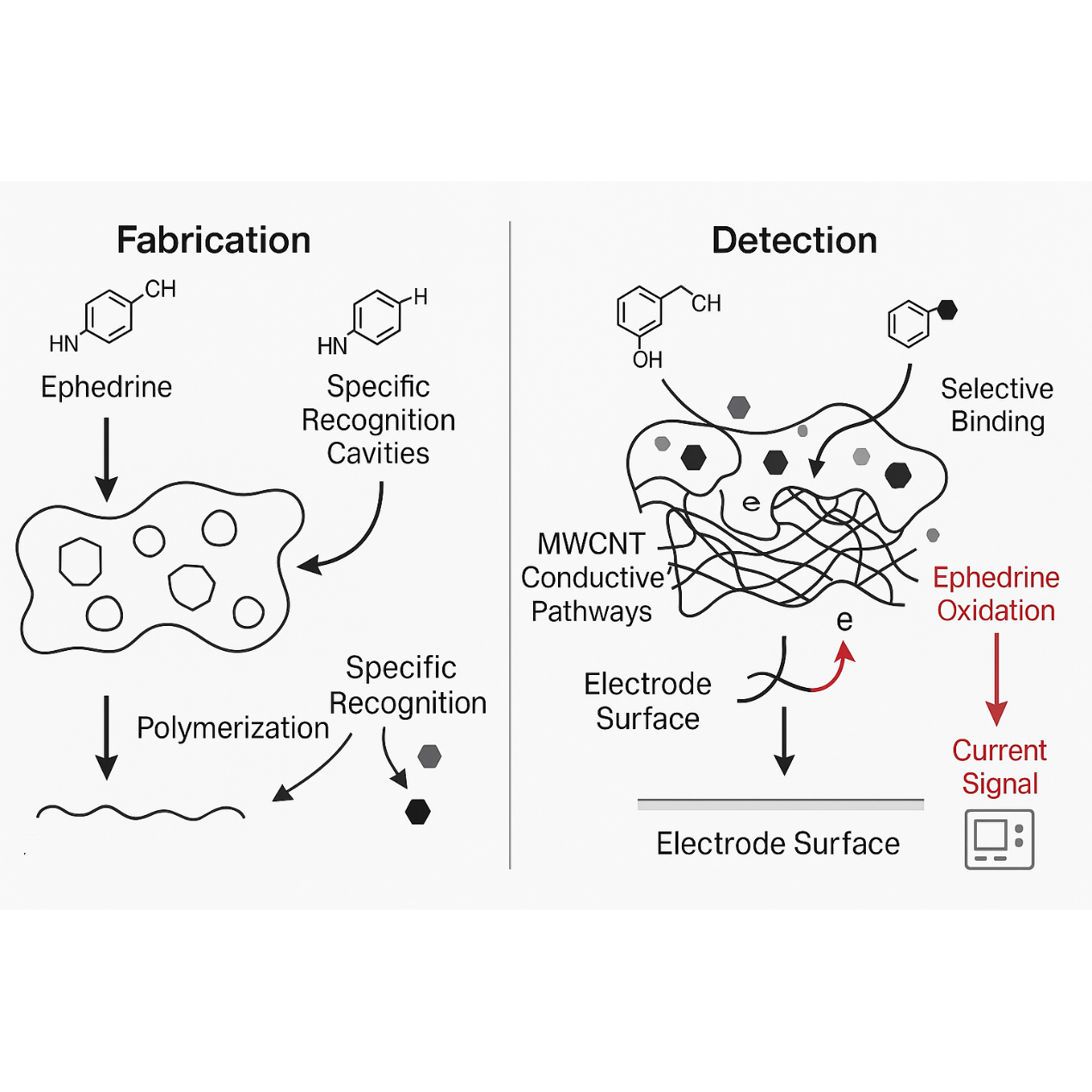  This work is licensed under a Creative Commons Attribution 4.0 International License. Cite this article Ruiqing Dong, Liuyang Li, Baosheng Pu, and Nan Ding, Electrochemical Sensing of the Stimulant Ephedrine Using Conductive Polymer–Carbon Nanotube Composite Film-modified Electrodes, Sens. Mater., Vol. 37, No. 10, 2025, p. 4347-4364. |
Forthcoming Regular Issues
Forthcoming Special Issues
Special Issue on Novel Sensors, Materials, and Related Technologies on Artificial Intelligence of Things Applications
Guest editor, Teen-Hang Meen (National Formosa University), Wenbing Zhao (Cleveland State University), and Cheng-Fu Yang (National University of Kaohsiung)
Call for paper
Special Issue on Mobile Computing and Ubiquitous Networking for Smart Society
Guest editor, Akira Uchiyama (The University of Osaka) and Jaehoon Paul Jeong (Sungkyunkwan University)
Call for paper
Special Issue on Advanced Materials and Technologies for Sensor and Artificial- Intelligence-of-Things Applications (Selected Papers from ICASI 2026)
Guest editor, Sheng-Joue Young (National United University)
Conference website
Call for paper
Special Issue on Innovations in Multimodal Sensing for Intelligent Devices, Systems, and Applications
Guest editor, Jiahui Yu (Research scientist, Zhejiang University), Kairu Li (Professor, Shenyang University of Technology), Yinfeng Fang (Professor, Hangzhou Dianzi University), Chin Wei Hong (Professor, Tokyo Metropolitan University), Zhiqiang Zhang (Professor, University of Leeds)
Call for paper
Special Issue on Advanced Materials and Technologies for Sensor and Artificial- Intelligence-of-Things Applications (Selected Papers from ICASI 2025)
Guest editor, Sheng-Joue Young (National United University)
Conference website
Call for paper
Special Issue on Multisource Sensors for Geographic Spatiotemporal Analysis and Social Sensing Technology Part 5
Guest editor, Prof. Bogang Yang (Beijing Institute of Surveying and Mapping) and Prof. Xiang Lei Liu (Beijing University of Civil Engineering and Architecture)
-
For more information of Special Issues (click here)
-
Special Issue on Advanced GeoAI for Smart Cities: Novel Data Modeling with Multi-source Sensor Data
- Accepted papers (click here)
- Voltage Reflex and Equalization Charger for Series-connected Batteries
Cheng-Tao Tsai and Jia-Wei Lin
- Voltage Reflex and Equalization Charger for Series-connected Batteries
- Accepted papers (click here)
- Design and Development of a Fuzzy-logic-based Long-range Aquacult ure System
Sheng-Tao Chen and Tai-I Chou
- Design and Development of a Fuzzy-logic-based Long-range Aquacult ure System
Guest editor, Prof. Changfeng Jing (China University of Geosciences Beijing)
Call for paper
Special Issue on Materials, Devices, Circuits, and Analytical Methods for Various Sensors (Selected Papers from ICSEVEN 2025)
Guest editor, Chien-Jung Huang (National University of Kaohsiung), Mu-Chun Wang (Minghsin University of Science and Technology), Shih-Hung Lin (Chung Shan Medical University), Ja-Hao Chen (Feng Chia University)
Conference website
Call for paper
Special Issue on Sensing and Data Analysis Technologies for Living Environment, Health Care, Production Management, and Engineering/Science Education Applications (2025)
Guest editor, Chien-Jung Huang (National University of Kaohsiung), Rey-Chue Hwang (I-Shou University), Ja-Hao Chen (Feng Chia University), Ba-Son Nguyen (Lac Hong University)
Call for paper
Special Issue on Advances in Sensors and Computational Intelligence for Industrial Applications
Guest editor, Chih-Hsien Hsia (National Ilan University)
Call for paper
Special Issue on AI-driven Sustainable Sensor Materials, Processes, and Circular Economy Applications
Guest editor, Shih-Chen Shi (National Cheng Kung University) and Tao-Hsing Chen (National Kaohsiung University of Science and Technology)
Call for paper
- Accepted papers (click here)
Copyright(C) MYU K.K. All Rights Reserved.