
Young Researcher Paper Award 2025
🥇Winners
🥇Winners
Print: ISSN 0914-4935
Online: ISSN 2435-0869
Sensors and Materials
is an international peer-reviewed open access journal to provide a forum for researchers working in multidisciplinary fields of sensing technology.
Online: ISSN 2435-0869
Sensors and Materials
is an international peer-reviewed open access journal to provide a forum for researchers working in multidisciplinary fields of sensing technology.
Tweets by Journal_SandM
Sensors and Materials
is covered by Science Citation Index Expanded (Clarivate Analytics), Scopus (Elsevier), and other databases.
Instructions to authors
English 日本語
Instructions for manuscript preparation
English 日本語
Template
English
Publisher
MYU K.K.
Sensors and Materials
1-23-3-303 Sendagi,
Bunkyo-ku, Tokyo 113-0022, Japan
Tel: 81-3-3827-8549
Fax: 81-3-3827-8547
MYU Research, a scientific publisher, seeks a native English-speaking proofreader with a scientific background. B.Sc. or higher degree is desirable. In-office position; work hours negotiable. Call 03-3827-8549 for further information.

MYU Research
(proofreading and recording)

MYU K.K.
(translation service)
The Art of Writing Scientific Papers
(How to write scientific papers)
(Japanese Only)
is covered by Science Citation Index Expanded (Clarivate Analytics), Scopus (Elsevier), and other databases.
Instructions to authors
English 日本語
Instructions for manuscript preparation
English 日本語
Template
English
Publisher
MYU K.K.
Sensors and Materials
1-23-3-303 Sendagi,
Bunkyo-ku, Tokyo 113-0022, Japan
Tel: 81-3-3827-8549
Fax: 81-3-3827-8547
MYU Research, a scientific publisher, seeks a native English-speaking proofreader with a scientific background. B.Sc. or higher degree is desirable. In-office position; work hours negotiable. Call 03-3827-8549 for further information.
MYU Research
(proofreading and recording)
MYU K.K.
(translation service)
The Art of Writing Scientific Papers
(How to write scientific papers)
(Japanese Only)
Sensors and Materials, Volume 38, Number 5(3) (2026)
Copyright(C) MYU K.K.
Copyright(C) MYU K.K.
|
pp. 2871-2890
S&M4475 Research paper https://doi.org/10.18494/SAM6363 Published: May 29, 2026 Sensor-Integrated Heat Dissipation Design and Its Optimization for Routers with Thermal Load [PDF] Min-Chie Chiu, Ho-Chih Cheng, Yu-HsinWang, Shih-Ming Cho, and Tian-Syung Lan (Received March 31, 2026; Accepted May 8, 2026) Keywords: temperature sensors, thermal monitoring, CFD, cooling, controller, router system, optimization, control
In the era of 5G and big data transmission, heat dissipation challenges for critical components such as CPUs and bi-directional optical sub-assembly (BOSA) modules must be addressed. In this study, we developed an intelligent, sensor-integrated cooling design that combines high thermal conductivity materials with topology-based flow field optimization to enhance thermal reliability. A hybrid structure of natural and forced convection was employed, regulated by embedded temperature sensors and a microcontroller. When component temperatures approached their operational limits (90 ℃ for BOSA and 105 ℃ for CPU), the system activated a 6.0 mm fan to ensure safe operation. Experimental validation tests and high-fidelity computational fluid dynamics simulations were conducted using calibrated K-type thermocouples and the SIMPLEST algorithm, respectively. The mesh-independent simulation results confirmed numerical accuracy, with only 0.7% error relative to experimental data. Topology optimization was performed to identify the optimal CPU heat sink parameters (fin height = 20 mm, fin width = 1 mm, and number of fins = 9), reducing CPU temperature to 93 ℃. The novelty of this study lies not only in extending prior research on laptop thermal management (primarily focused on CPU-only systems), but also in further applying the control strategy to the thermal design of high-heat-generation routers that incorporate both CPUs and bi-directional optical sub-assembly (BOSA) modules in practical applications. The results demonstrate that shifting sensors from passive monitoring to active regulation significantly improves cooling efficiency, offering a robust framework for next-generation portable electronics under high thermal stress. Future research may further advance this approach by developing optimal fan cooling strategies that dynamically adjust fan speed in response to real-time temperature variations. In addition, given the impact of fan noise on user comfort, subsequent studies should integrate acoustic modeling with thermal performance simulations to achieve a balanced design that simultaneously satisfies both noise constraints and cooling efficiency.
Corresponding author: Min-Chie Chiu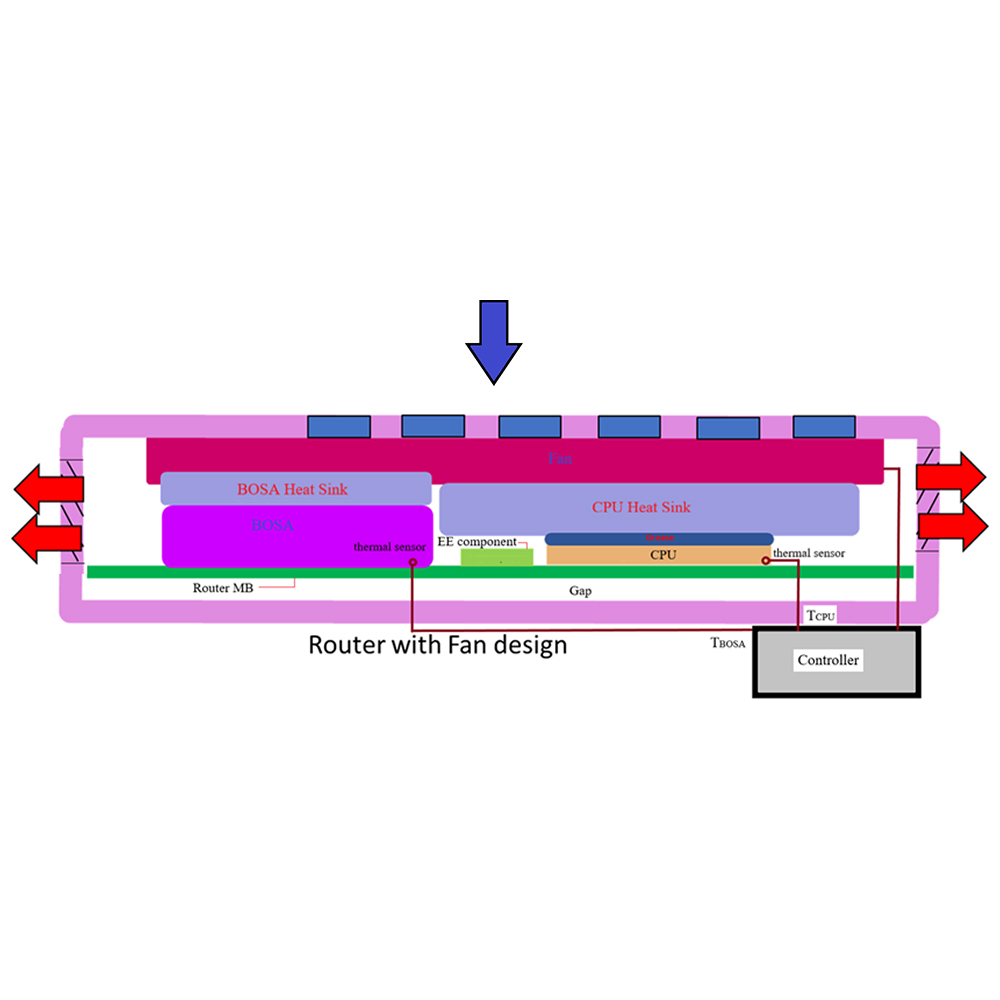  This work is licensed under a Creative Commons Attribution 4.0 International License. Cite this article Min-Chie Chiu, Ho-Chih Cheng, Yu-HsinWang, Shih-Ming Cho, and Tian-Syung Lan, Sensor-Integrated Heat Dissipation Design and Its Optimization for Routers with Thermal Load, Sens. Mater., Vol. 38, No. 5, 2026, p. 2871-2890. |
Forthcoming Regular Issues
Forthcoming Special Issues
Special Issue on Signal Collection, Processing, and System Integration in Automation Applications 2026
Guest editor, Hsiung-Cheng Lin (National Chin-Yi University of Technology), Ming-Te Chen (National Chin-Yi University of Technology), and Chin-Yi Cheng (National Yunlin University of Science and Technology)
Call for paper
Special Issue on Advanced Sensor Application Development
Guest editor, Shih-Chen Shi (National Cheng Kung University) and Tao-Hsing Chen (National Kaohsiung University of Science and Technology)
Call for paper
Special Issue on Sensing Beyond Transduction: Materials, Devices, and Signal Processing for Intelligent Sensory Systems
Guest editor, Masayuki Sohgawa (Niigata University)
Call for paper
Special Issue on Advanced Materials and Technologies for Sensor and Artificial- Intelligence-of-Things Applications (Selected Papers from ICASI 2026)
Guest editor, Sheng-Joue Young (National Yunlin University of Science and Technology)
Conference website
Call for paper
Special Issue on Biosensing Devices
Guest editor, Kiyotaka Sasagawa (Nara Institute of Science and Technology)
Call for paper
Special Issue on Mobile Computing and Ubiquitous Networking for Smart Society
Guest editor, Akira Uchiyama (The University of Osaka) and Jaehoon Paul Jeong (Sungkyunkwan University)
Call for paper
-
For more information of Special Issues (click here)
-
Special Issue on Novel Sensors, Materials, and Related Technologies on Artificial Intelligence of Things Applications
- Accepted papers (click here)
- Negative Temperature Coefficient Thermistor with Multilayer Thin-film Structure AlN/VOx/AlN on Si(100) Substrate
Chen-Hung Yen, Ing-Jiunn Su, and Hui-Huang Hsieh
- Negative Temperature Coefficient Thermistor with Multilayer Thin-film Structure AlN/VOx/AlN on Si(100) Substrate
- Accepted papers (click here)
- Design and Development of a Fuzzy-logic-based Long-range Aquaculture System
Sheng-Tao Chen and Tai-I Chou - Payload Measurement of Heavy Vehicles by Measuring Deflection of Leaf Springs for Use of IoT
Shan-Kuo Yang and Kai-Jung Chen
- Design and Development of a Fuzzy-logic-based Long-range Aquaculture System
Guest editor, Teen-Hang Meen (National Formosa University), Wenbing Zhao (Cleveland State University), and Cheng-Fu Yang (National University of Kaohsiung)
Call for paper
Special Issue on Low-altitude Economy: Technologies, Infrastructure, and Applications
Guest editor, He Huang and Junxing Yang (Beijing University of Civil Engineering and Architecture)
Call for paper
Special Issue on Materials, Devices, Circuits, and Analytical Methods for Various Sensors (Selected Papers from ICSEVEN 2026)
Guest editor, Chien-Jung Huang (National University of Kaohsiung), Mu-Chun Wang (Minghsin University of Science and Technology), Shih-Hung Lin (Chung Shan Medical University), Ja-Hao Chen (Feng Chia University)
Conference website
Call for paper
Special Issue on Sensing and Data Analysis Technologies for Living Environment, Health Care, Production Management, and Engineering/Science Education Applications (2026)
Guest editor, Chien-Jung Huang (National University of Kaohsiung), Rey-Chue Hwang (I-Shou University), Ja-Hao Chen (Feng Chia University), Ba-Son Nguyen (University of Economics Ho Chi Minh City)
Call for paper
Special Issue on Multisource Sensors for Resource and Environmental Monitoring: Theories, Models, Methods, and Application
Guest editor, Chao Chen (Suzhou University of Science and Technology)
Call for paper
Special Issue on Spatial Intelligence, Digital Twins, and AI-driven Smart Systems for Next-Generation Built Environment
Guest editor, Jaekang Lee (Dong-A University), Myeong Hun Jeong (Chosun University), and Dong Ha Lee (Kangwon National University),
Call for paper
Special Issue on Advances in Sensors and Computational Intelligence for Industrial Applications: Part 2 (submission closed)
Guest editor, Chih-Hsien Hsia (National Ilan University)
Call for paper
Special Issue on Intelligent Sensing and AI-driven Optimization for Sustainable Smart Manufacturing
Guest editor, Cheng-Chi Wang (National Sun Yat-sen University)
Call for paper
- Accepted papers (click here)
Copyright(C) MYU K.K. All Rights Reserved.